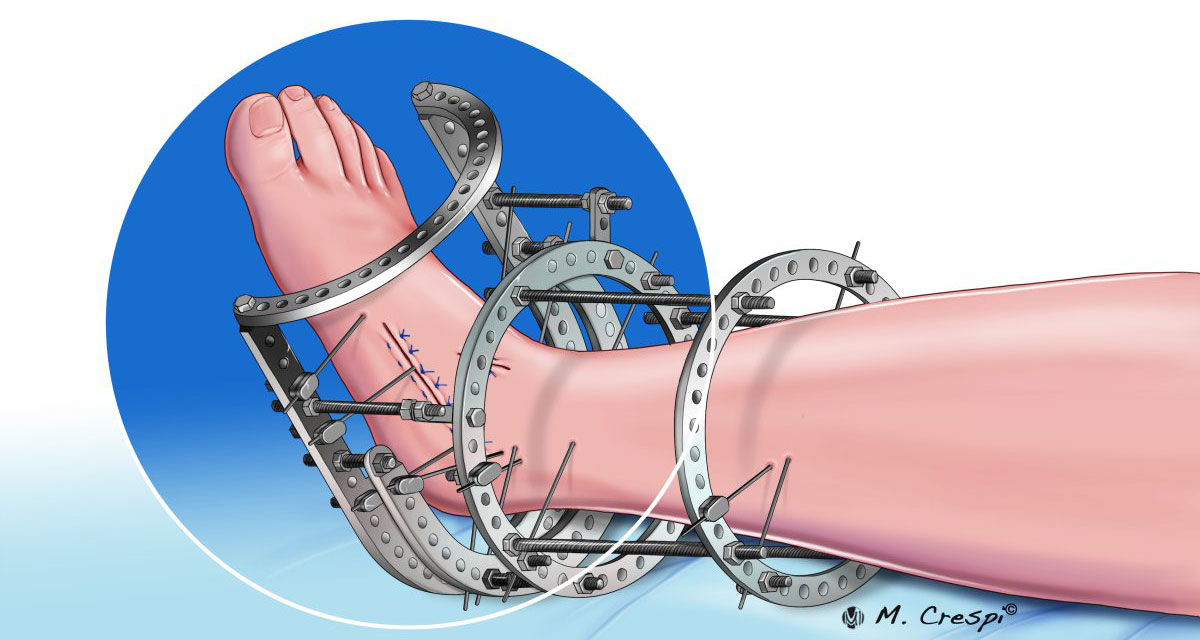
Orthofix was founded on a legacy of innovation in Extremity Deformity Correction that continues to guide and inspire the development of our devices across multiple portfolios. In 1980, Orthofix founder Giovanni De Bastiani developed a modular external device designed to create the most favorable physiological conditions at each stage of fracture healing. This served as a cornerstone in the development of additional Orthofix devices, such as the TrueLok™ family of ring fixators. 

Read More
Limb lengthening is a complex orthopedic procedure designed to gradually increase the length of long bones, most commonly the femur, tibia, or humerus. The technique is based on the biological principle of distraction osteogenesis, in which a surgically created bone cut (corticotomy or osteotomy) is slowly distracted, allowing new bone tissue to regenerate in the gap while the surrounding soft tissues – muscles, nerves, and vessels – adapt to the progressive elongation. It represents a highly specialized field within limb reconstruction, requiring precise surgical technique, meticulous planning, and careful postoperative management to minimize complications and optimize functional outcomes.

Read More

In the evolving landscape of orthopedic surgery, enabling technologies are becoming integral to clinical practice, supporting greater precision, efficiency, and consistency in treatment delivery.

Read More

Complex fractures represent one of the most demanding areas in limb-reconstruction surgery. These injuries are frequently caused by high-energy mechanisms and are often associated with severe comminution, periarticular fractures, bone loss, nonunions, and a significant risk of infection—often in polytrauma contexts where soft tissue protection and early stability are paramount. No two cases are the same—constructs must be tailored to biomechanics, soft tissue condition, and the patient’s physiology. Most of the time, the chosen surgical approach must help orchestrate staged care from damage control to definitive reconstruction, enabling progressive loading over time, while maintaining focus on function, alignment, and long-term durability.

Read More

Limb preservation represents one of the most transformative areas in modern orthopedics, where innovation, clinical collaboration, and improving patients' quality of life converge.

Read More

Orthofix is globally recognized as a leader in advanced limb reconstruction. With decades of experience and continuous innovation, the company has developed a comprehensive portfolio of solutions designed to address complex musculoskeletal conditions across all age groups. From external fixation systems to intramedullary lengthening nails and enabling technologies, Orthofix supports orthopedic surgeons in managing some of the most challenging congenital, developmental, and acquired orthopedic conditions across four key pillars: Limb Preservation, Limb Lengthening, Complex Fracture Management, and Extremity Deformity Correction.

Read More

Charcot neuroarthropathy of the ankle is an especially challenging condition that often leads to instability and destruction of the joint with significant morbidity requiring an amputation in many instances1-3. According to Brodsky et al., the ankle is affected in 9% of patients with Charcot neuroarthropathy, whereas the hindfoot is involved in 30-35%3. The overall goal of Charcot ankle reconstruction is to achieve a painless, plantigrade and stable foot, and thus avoid ulceration with subsequent infection1,2. However, this procedure is also associated with a high complication rate1,2.

Read More

The successful treatment of Charcot foot does not end with a completed surgery; success also requires a diligent postoperative care regime. This devastating condition mainly affects patients with diabetes and peripheral neuropathy, resulting in bone destruction and joint deformation1. During the initial, inflammatory stage, the recommended treatment consists of off-loading with total contact casts or custom orthotics to prevent further damage, although surgical management is indicated in cases of severe instability or soft tissue compromise2. After the acute stage, the focus of treatment is on deformity correction and foot reconstruction to prevent further damage and improve the patients’ quality of life2.

Read More

Surgical reconstruction of foot and ankle Charcot with external fixation is especially useful in the presence of poor bone quality, ulceration, compromised soft tissue, active infection, or osteomyelitis – cases in which the use of internal fixation is limited or contraindicated1.

Read More

Appropriate timing for surgical intervention is a matter of controversy among specialists1. While in the past Charcot foot surgical reconstruction was mainly reserved to salvage the limb, today surgeons also perform operative corrections to ensure patients can use commercially available footwear instead of cumbersome orthoses1. Regardless, the main goal of Charcot foot surgery, independent of the fixation method, is to create a stable and plantigrade foot. This article will discuss different approaches for Charcot foot surgery with internal fixation, focusing on midfoot reconstruction.

Read More