

Limb lengthening is a complex orthopedic procedure designed to gradually increase the length of long bones, most commonly the femur, tibia, or humerus. The technique is based on the biological principle of distraction osteogenesis, in which a surgically created bone cut (corticotomy or osteotomy) is slowly distracted, allowing new bone tissue to regenerate in the gap while the surrounding soft tissues – muscles, nerves, and vessels – adapt to the progressive elongation. It represents a highly specialized field within limb reconstruction, requiring precise surgical technique, meticulous planning, and careful postoperative management to minimize complications and optimize functional outcomes.
The Evolution of Bone Lengthening Devices
The practice of limb lengthening has a long history of innovation, evolving from external fixation to advanced intramedullary devices.
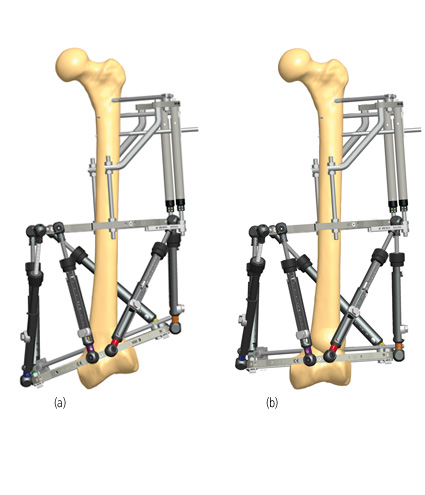
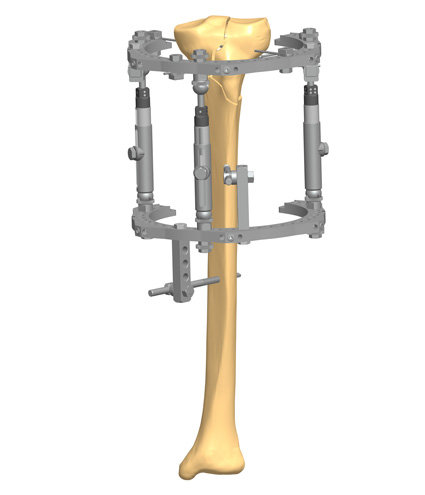
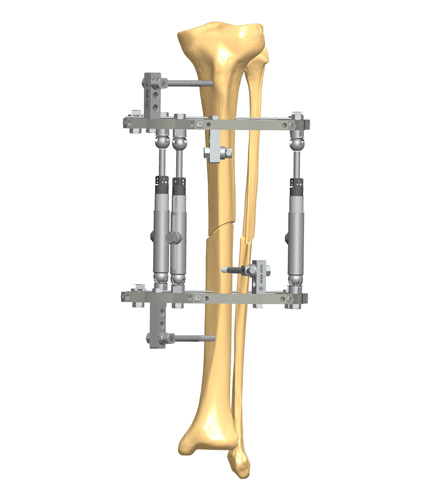
For an extended period, unilateral external fixators served as the conventional method for limb lengthening. These devices, although effective, came with significant drawbacks: pin-site infections, visible hardware, and long recovery periods. The method of acute and rapid distraction remained the standard of care until Ilizarov discovered the advantages of periosteum-preserving osteotomies followed by slow and incremental lengthening.1,2 The introduction of Ilizarov-type fixators, such as the Orthofix TrueLok™ system, brought forth the concept of circular external fixation, while hexapodal frames incorporating computer-assisted correction such as the Orthofix TL-HEX™, enabled simultaneous lengthening and bone deformity management.2 This discovery marked a turning point, as it emphasized biology-driven bone formation.2
Innovations such as lengthening over intramedullary nails and the combination of external fixation with plates emerged to streamline treatment duration.2
The latest advancement involves internal bone lengthening devices, reducing the need for external fixation. The main mode of action of lengthening nails can be divided into ratchet-based devices and nails driven by motors.3 Ratchet-based devices required the manual rotation of the limb at the osteotomy site, which was a painful procedure that often required anesthesia.3 Nowadays, implants are activated by external signals, including radiofrequency and magnetic signals.2
The Fitbone Solution
Among motorized intramedullary devices, the Orthofix Fitbone™ system represents one of the most established and reliable technologies. Developed in collaboration with Professor Baumgart, one of the leading specialists in intramedullary nailing, and launched in 1997, Fitbone has become a worldwide reference for intramedullary lengthening. Its design combines mechanical strength with controlled, electromechanical energy transmission via a subcutaneous receiver, ensuring consistent lengthening regardless of body habitus. This feature is particularly valuable in muscular or obese patients, where magnetic systems may fail to transmit energy effectively.
Since its inception, this treatment approach has evolved into a worldwide success, boasting numerous accomplished implants. Through meticulous preoperative planning, it becomes feasible to incorporate axial and torsional corrections within the limb lengthening process. A dedicated module of the OrthoNext™ pre-planning software for the Fitbone Intramedullary Limb Lengthening system, based on the reverse planning approach, is available and enables a more accurate preoperative evaluation.
“One of the greatest advantages of Fitbone is the reliability of its receiver,” notes Dr. Virginia Casey, pediatric orthopedic surgeon in Charlotte, North Carolina. “Other devices using magnets may not work if the distance between the skin and the nail is too large. With Fitbone, this is not an issue.”
Indications for Intramedullary Lengthening
The indications for intramedullary lengthening are various. Dr. Casey shares some insights from her daily work: “The most common condition for intramedullary lengthening is idiopathic leg length discrepancy, including congenital short femur. Other conditions are hemihypertrophy (mainly due to idiopathic reasons), traumatic growth arrests, and Ollier’s disease. In general, intramedullary lengthening is very suitable for little or moderate deformities in combination with length discrepancies.”
Traditional teaching recommends limb lengthening for discrepancies of more than 4 cm, whereas discrepancies between 2 to 4 cm can be either treated conservatively or with lengthening.2 However, additional factors such as the patient’s height, heel size, the effect of a shoe lift, and social factors have become more important.1 Dr. Casey confirms: “In general, lengthening nails simplified the procedure compared to external fixators. The indications have broadened. In the past, lengthening was only offered to patients with leg length discrepancies of at least 4 cm. Meanwhile, lengthening can also be offered to patients with leg length discrepancies of 2 cm.”
Preoperative Planning for Lengthening Procedures
Accurate planning is crucial for safe and effective outcomes. The OrthoNext platform provides a dedicated Fitbone Reverse Planning Method module for lengthening nails. From preoperative planning assessment, through simulation of osteotomy positioning and blocking screw placement, the module supports the surgeon with accurate calibration, and optimized inventory sent to the operating room with the goal to optimize outcomes. Dr. David Frumberg, orthopedic surgeon and limb reconstruction specialist in New Haven, Connecticut, explains the benefits of thorough preoperative planning: “The reverse planning method allows you to see where you are going to end up and you can ensure that the overall alignment is accurate. It allows you to avoid inducing deformity where no deformity was before. OrthoNext is great for that.”
Lengthening With Intramedullary Nails Versus External Fixators
External fixators are the main alternative for limb lengthening. Monolateral external fixators are suitable for simple lengthening of different pathologies and in the case of minor deformities, and have a short learning curve.4 Hexapod fixators allow more precise correction of complex deformities.4
The combination of lengthening with external and internal fixation, including intramedullary nails or locking plates, has reduced external fixation times and complication rates, while improving anatomic and functional results. 4 Lengthening nails allow for a faster recovery of range of motion and return to activity during lengthening and consolidation.4
Dr. Casey also explains the importance of considering the status of the physis and the patient’s age: ”The status of the physis and the patient’s age are really important. If a patient is too small or too young, then you have to use an external fixator. Another thing to consider, especially in congenital short femur, are knee deficiencies such as deficiencies of the anterior cruciate ligament. If you are worried about knee subluxation through lengthening, then it might be necessary to span the knee. For me, it’s easier to span the knee with a frame rather than inserting a nail and spanning the knee with a frame after that.”
Dr. Casey says that Fitbone provides several clinical and patient-centered benefits:
- Elimination of pin-site infections and skin irritation
- Improved patient comfort, as there is no visible external hardware
- Faster recovery of range of motion
- Earlier weight-bearing due to the strength of its stainless-steel design
- High reliability of distraction mechanics via the electromechanical receiver
For patients, the difference is striking. “Patients treated with Fitbone often say the device feels futuristic, almost bionic,” shares Dr. Casey. “This positive perception contributes to their engagement and motivation during treatment.”
Explore real-world limb reconstruction cases and deepen your clinical practice: access the dedicated clinical resources here.
Complications With Intramedullary Lengthening
Complications can occur at any stage of the lengthening process, from the intraoperative stage to the lengthening and the consolidation stage. Different categories of complications should be considered, including the ones related to implant failure, soft tissue or joint contractures, or complications related to the regenerate or bone in general.5
With motorized lengthening nails such as Fitbone, device malfunctions, poor local bony and soft-tissue biology, patient compliance, neurovascular compromise, joint instability, and regenerate problems should be considered.6,7 Typically, complications are graded to their severity according to Black et al. depending on whether the complication results in a minimal intervention (Grade I) or a failure to achieve the treatment goal (Grade III).8
Dr. Casey highlights: “In terms of knee dislocation, one must be careful with congenital disorders: if ligaments are not reconstructed, then this is a risk factor. Make sure you have a good postoperative protocol with a knee immobilizer and weekly follow-ups and keep an eye on it. Knee dislocations are less likely in lengthening for traumatic conditions.”
Importantly, her experience with device reliability has been highly positive. “I have never had to remove or replace a Fitbone nail because of device failure.”
Strength, Stability, and Rehabilitation
One of Fitbone’s defining advantages is its stainless-steel construction, which provides superior mechanical strength compared to titanium.
Dr. Casey applies a flexible rehabilitation protocol, encouraging patients to regain knee mobility quickly while tailoring physiotherapy requirements to their access and needs. “Not all patients have easy access to physical therapy,” she notes. “That’s why I individualize protocols. Sometimes therapy is essential, other times patients recover well with guided exercises alone.”
Patient Perception and Satisfaction
Beyond technical outcomes, patient satisfaction is a central component of Fitbone’s success. The absence of external pins and frames reduces the psychological burden, while the “bionic” aspect of the device often inspires confidence and a sense of empowerment in patients.
“Some patients are not thrilled about the subcutaneous receiver,” admits Dr. Casey. “But overall, they see Fitbone as a cool, high-tech solution. Their positive attitude helps in adherence and recovery.”
Case Reports
A clinical case further illustrates the application of intramedullary lengthening in the presence of a complex deformity. A 13.5-year-old patient with X-linked hypophosphatemia presented with femoral deformities and a 32 mm limb length discrepancy following previous guided growth procedures.
Treatment was performed in two stages, with the second stage involving correction and lengthening using the Fitbone Intramedullary Lengthening System. Lengthening was achieved at a rate of 1 mm/day over 31 days, followed by progressive consolidation, with full weight-bearing allowed four weeks after completion of lengthening.
The procedure resulted in restored limb alignment, equalized limb length, and successful bone consolidation, with high patient satisfaction reported at long-term follow-up.
This case demonstrates how intramedullary lengthening may effectively address a combined limb deformity and length discrepancy while improving patient comfort and functional recovery.
Download the full case report to explore surgical planning, execution, and follow-up outcomes in detail.
The case report shows an individual’s response to treatment. The information contained in this case report is provided for informational and educational purposes. It is not intended to guarantee the response other people may have to treatment as individual results can and do vary. Proper surgical procedure is the responsibility of the medical professional. Each surgeon must evaluate the appropriateness of a technique based on his or her personal medical credentials and experience.
Orthofix Limb Lengthening Portfolio
Orthofix’s Limb Lengthening portfolio offers both external and internal fixation solutions that make the surgical process more precise, comfortable, and effective for patients. The Limb Lengthening portfolio includes the Fitbone Intramedullary Lengthening System, TrueLok Ring Fixation System, TL-HEX TrueLok Hexapod System and the LRS Advanced Limb Reconstruction System. Learn more on Orthofix.com.
Education and Orthofix Academy
Orthofix Orthopedics has redefined its global focus to concentrate on Limb Reconstruction, addressing complex congenital, developmental, and acquired conditions in patients of all ages.
To maximize surgical outcomes, Orthofix provides a series of resources complemented by Orthofix Academy, a dedicated platform for education and skill development in limb reconstruction.
By combining innovative technology with continuous learning opportunities, Orthofix supports surgeons in delivering the highest standards of care.
Stay Connected
- Instagram: Follow @OrthofixOrthopedics for exclusive tips, updates, and stories from the field.
- LinkedIn: Connect with us on our corporate LinkedIn Page to access news, thought leadership, industry updates, and career opportunities.
- YouTube: Subscribe to the Orthofix Orthopedics YouTube channel for educational videos.
Follow us today and join this growing community, united by a shared passion and mission to improve the lives of our patients.
The information in this article is intended exclusively for healthcare professionals. Federal law (USA) restricts these devices to sale by or on the order of a physician. Proper surgical procedure is the responsibility of the medical professional. Operative techniques are furnished as an informative guideline. Each surgeon must evaluate the appropriateness of a technique based on his or her personal medical credentials and experience.
Dr. Virginia Casey is a paid consultant of Orthofix.
References
- Hasler CC, Krieg AH. Current concepts of leg lengthening. J Child Orthop. Jun 2012;6(2):89-104. doi:10.1007/s11832-012-0391-5
- Hosny GA. Limb lengthening history, evolution, complications and current concepts. J Orthop Traumatol. Mar 5 2020;21(1):3. doi:10.1186/s10195-019-0541-3
- Calder PR, Wright J, Goodier WD. An update on the intramedullary implant in limb lengthening: A quinquennial review Part 1: The further influence of the intramedullary nail in limb lengthening. Injury. Nov 2022;53 Suppl 3:S81-s87. doi:10.1016/j.injury.2022.06.028
- Pejin Z. Femoral lengthening in children and adolescents. Orthop Traumatol Surg Res. Feb 2017;103(1s):S143-s149. doi:10.1016/j.otsr.2016.05.020
- Calder PR, Laubscher M, Goodier WD. The role of the intramedullary implant in limb lengthening. Injury. Jun 2017;48 Suppl 1:S52-s58. doi:10.1016/j.injury.2017.04.028
- Morrison SG, Georgiadis AG, Huser AJ, Dahl MT. Complications of Limb Lengthening With Motorized Intramedullary Nails. J Am Acad Orthop Surg. Sep 15 2020;28(18):e803-e809. doi:10.5435/jaaos-d-20-00064
- Frost MW, Rahbek O, Traerup J, Ceccotti AA, Kold S. Systematic review of complications with externally controlled motorized intramedullary bone lengthening nails (FITBONE and PRECICE) in 983 segments. Acta Orthop. Feb 2021;92(1):120-127. doi:10.1080/17453674.2020.1835321
- Black SR, Kwon MS, Cherkashin AM, Samchukov ML, Birch JG, Jo CH. Lengthening in Congenital Femoral Deficiency: A Comparison of Circular External Fixation and a Motorized Intramedullary Nail. J Bone Joint Surg Am. Sep 2 2015;97(17):1432-40. doi:10.2106/jbjs.N.00932


