

The Value of Preoperative Planning in Limb Reconstruction
In the evolving landscape of orthopedic surgery, enabling technologies are becoming integral to clinical practice, supporting greater precision, efficiency, and consistency in treatment delivery.
These technologies – including computer-assisted surgical systems, smart devices, monitoring tools, and digital planning platforms – are reshaping the way orthopedic procedures are approached, offering surgeons enhanced capabilities for diagnosis, planning, and intraoperative execution.
Within this framework, preoperative planning is widely recognized as a fundamental component of successful orthopedic surgery, particularly in limb reconstruction.
Thorough planning enables surgeons to visualize the procedure in advance, anticipate potential challenges, and refine surgical strategies to mitigate intraoperative complications. This phase is essential not only in complex deformity corrections but also in routine cases, where digital tools contribute to reproducibility and standardization of outcomes.
OrthoNext™ Platform System was developed to assist surgeons in their daily pre-operative planning of orthopedic surgery. It is a web-based planning application specifically designed for limb reconstruction procedures. Its Fitbone™ module assist surgeons in a precise implant selection, accurate simulation and calibration of intramedullary lengthening procedures, in order to achieve optimal mechanical alignment and patient outcomes.
From Conventional to Digital Planning
Traditionally, surgeons relied on printed radiographs and manual measurements to trace axes and angles. These methods, while functional, were time-consuming and prone to human error. With the advent of digital radiography and specialized software, the transition from analog to digital planning marked a significant advance. Digital planning improves accuracy, facilitates reproducibility, and enhances efficiency in the operating room.¹
Current evidence indicates that integrating these advanced planning methods and briefings into orthopedic practices significantly influences favorable outcomes in orthopedic procedures.1 The evolving landscape of preoperative planning aligns with technological progress and an enhanced understanding of surgical safety protocols.1
As David Frumberg, MD (Yale School of Medicine, New Haven, CT) notes: “You can use OrthoNext for any kind of deformity corrections in the lower limbs. I use it for all complicated cases because it allows some ‘trial and error’ before the surgery. But it is also useful for more simple procedures because of the excellent calibration. My OR can be set up with the exact components, and the rest is only about executing the surgery which is already very well planned in advance.”
The versatility of the OrthoNext platform in complex cases is illustrated in a case-report, where a 13.5-year-old patient presented with multiple deformities due to untreated rickets despite previous surgical interventions. For this case, Dr. Frumberg prepared a 2-step treatment strategy, using the OrthoNextsoftware in the second step, to determine the angular correction and limb length discrepancy correction that could be achieved to carefully pre-plan. The key points of the deformity analysis are described below.
Download the case report available here for more information about preoperative planning with OrthoNext.
The case report shows an individual’s response to treatment. The information contained in this case report is provided for informational and educational purposes. It is not intended to guarantee the response other people may have to treatment as individual results can and do vary. Proper surgical procedure is the responsibility of the medical professional. Each surgeon must evaluate the appropriateness of a technique based on his or her personal medical credentials and experience.
Clinical Applications Across Limb Reconstruction
The OrthoNext platform is designed to support a wide spectrum of limb reconstruction procedures. These include extremity deformity correction and limb lengthening . Its versatility makes it useful for both complex reconstructions and straightforward cases where accurate alignment and efficiency are equally important.
Digital planning enables surgeons to:
- Define deformities with accuracy
- Choose the appropriate surgical strategy
- Anticipate and mitigate potential complications
- Optimize intraoperative workflows through precise preparation
By combining analytical tools and intuitive navigation, OrthoNext helps transform planning from a manual task into a streamlined digital process.
Deformity Analysis: The MAP Strategy
A key component of successful limb reconstruction is thorough deformity analysis. OrthoNext incorporates the MAP strategy – Measure, Analyze, Pick – to provide a systematic approach, based on the following three steps:²
- Measure the mechanical axis deviation
- Analyze the joint angles
- Pick the deformed bone.
The strategy was first described in the well-known textbook “The Art of Limb Alignment” and is considered the standard method for deformity analysis.2 The MAP tool of OrthoNextprovides the following outputs to the surgeon, among others: mechanical and anatomical axis, the neck-shaft angle of the femur, the weight-bearing line, and the deformity apex.
The OrthoNext Fitbone module uses the principle of an “8 points positioning routine” to easily find all the above-mentioned deformity parameters describing the limb alignment. A total of 8 points is considered the minimum (considering a full-length leg) number of points to find all the relevant deformity parameters.2
This standardized process supports precision in planning and reproducibility in outcomes.
Reverse Planning for Fitbone Procedures
With external fixators, surgeons are free to define the lengthening axis, but intramedullary devices are constrained by bone anatomy. OrthoNext addresses this with the Reverse Planning technique. The technique was first described by Prof. Baumgart et al. in 2009.3 The planning starts with identifying the ideal results of the planned correction and retraces it back to the existing deformity.3 Geometric measurements are employed to define the mechanical axis of the lower limb, as well as the bone and joint orientation to it.3
Dr. Frumberg highlights the importance of this approach: “With internal devices you are confined to the anatomy of the bones. Compared to the tibia, the femur is a bit valgus – about 6 to 7 degrees. With an external device you can place it anywhere. But with an internal device you may distort the angulation. The reverse planning method allows you to see where you are going to end up and ensures that the overall alignment is accurate. It avoids inducing deformity where none existed before. OrthoNext is great for that – you just tell the system you want to do reverse planning, and it guides you through the completion of all steps with a few clicks.”
Figure 1 shows the different steps of the Reverse Planning technique of the previously mentioned case-report. For this case, Dr. Frumberg explained that “angular deformity with shortening can be difficult to treat simultaneously with internal fixation,” which makes “virtual pre-operative planning key to successful execution of the plan during the surgery.”
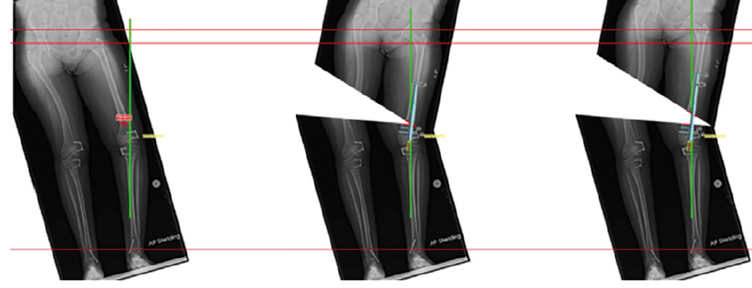
Figure 1. Images from the OrthoNext software highlighting the pre-planning process.
Accuracy and Intraoperative Efficiency
Many planning methods rely on performing all measurements with Picture Archiving and Communication Systems (PACS) and software programs in one plane.4 Even though these measurements were shown to be suitable for deformity planning and education,4 they inherit certain limitations.
Dr. Frumberg provides the following insights: “The advantage of OrthoNext is that it is biplanar; whereas, other software only allows planning in one plane. With planning in one plane only, one might miss important information about other deformities that then need to be addressed during the surgery without appropriate planning.”
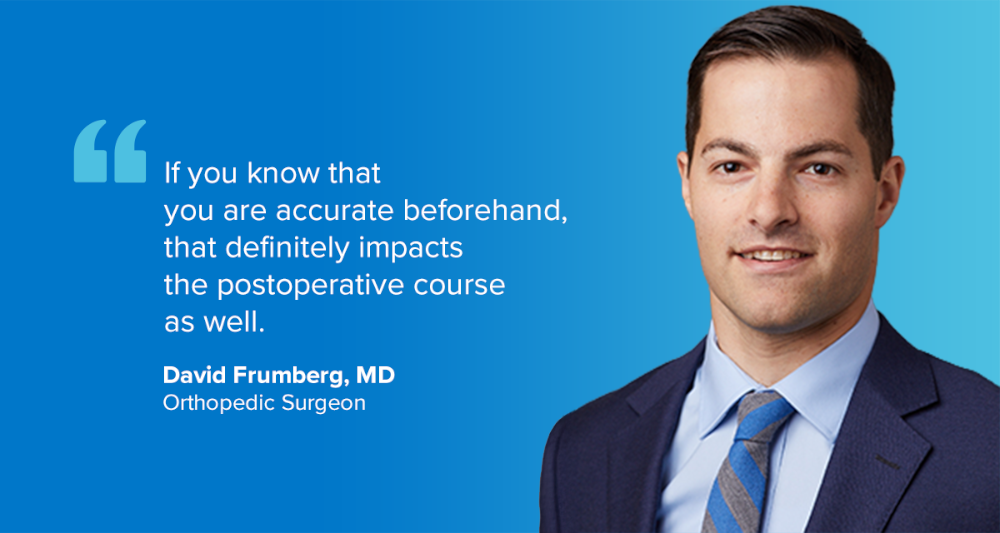
Besides higher accuracy, preoperative planning inherits further benefits including templating. The surgical team is able to equip the operating room with the required implant sizes and suitable alternatives.5 Additionally, it establishes a readily available, archived documentation of the preoperative planning procedure, enabling various members of the surgical team to access the information as needed.5 Dr. Frumberg confirms: “If you know that you are accurate beforehand and that you are going to reach your goal, that definitely impacts the postoperative course as well.”
Communication with Patients and Families
Beyond the operating room, OrthoNext also supports surgeon-patient communication.
“Every time I do a Fitbone case, I show the report to the patient. It’s always useful to go through the X-rays to explain what is planned and why. When patients can see clearly where we expect to end up, it improves understanding and builds confidence,” explains Dr. Frumberg.
By providing clear and visual documentation, the platform reinforces patient education, strengthens trust, and improves compliance.
Emerging Technologies and Future Perspectives
Digital planning continues to evolve with new technologies. One of the most promising trends is the integration of 3D printing into preoperative planning. Patient-specific 3D models improve understanding of deformities and can reduce surgical time, blood loss, and radiation exposure.6 While challenges such as cost and production time remain, the integration of 3D technology enhances digital platforms like OrthoNext and offers further possibilities in limb reconstruction.
Another rapidly emerging technology transforming digital preoperative planning is artificial intelligence (AI). AI refers to computer-based systems that can interpret data in ways that mimic human cognitive processes and learn from experience over time. By leveraging large datasets and advanced algorithms, AI systems can recognize complex anatomical patterns, automate deformity classification, and predict surgical outcomes with increasing accuracy. In spine deformity surgery, AI-driven models have already been shown to support clinical decision-making by identifying optimal correction strategies and forecasting postoperative results based on patient-specific parameters.7
These models have demonstrated an ability to analyze complex clinical and radiographic information, classify deformity patterns, and forecast patient-specific results with promising levels of accuracy. By providing data-driven insights that supplement clinical judgement, AI has the potential to enhance decision-making, support more consistent planning strategies, and promote a more personalized approach to treatment.7
The latest developments demonstrate how AI can significantly enhance efficiency and precision during the planning phase, reducing manual workload while improving reproducibility. As AI capabilities expand, they are expected to further streamline digital workflows, facilitate personalized treatment planning, and ultimately make digital preoperative planning platforms more intuitive and widely adoptable by orthopedic surgeons. 7
Explore real-world limb reconstruction cases and deepen your clinical practice: access the dedicated clinical resources here.
Education and Orthofix Academy
Orthofix Orthopedics has redefined its global focus to concentrate on Limb Reconstruction, addressing complex congenital, developmental, and acquired conditions in patients of all ages.
To maximize surgical outcomes, Orthofix provides a series of resources complemented by Orthofix Academy, a dedicated platform for education and skill development in limb reconstruction.
By combining innovative technology with continuous learning opportunities, Orthofix supports surgeons in delivering the highest standards of care.
Stay Connected
- Instagram: Follow @OrthofixOrthopedics for exclusive tips, updates, and stories from the field.
- LinkedIn: Connect with us on our corporate LinkedIn Page to access news, thought leadership, industry updates, and career opportunities.
- YouTube: Subscribe to the Orthofix Orthopedics YouTube channel for educational videos.
Follow us today and join this growing community, united by a shared passion and mission to improve the lives of our patients.
The information in this article is intended exclusively for healthcare professionals. Federal law (USA) restricts these devices to sale by or on the order of a physician. Proper surgical procedure is the responsibility of the medical professional. Operative techniques are furnished as an informative guideline. Each surgeon must evaluate the appropriateness of a technique based on his or her personal medical credentials and experience.
Dr. David Frumberg is a paid consultant of Orthofix.
References
- Atesok K, Galos D, Jazrawi LM, Egol KA. Preoperative Planning in Orthopaedic Surgery. Current Practice and Evolving Applications. Bull Hosp Jt Dis (2013). Dec 2015;73(4):257-68.
- Standard SC, Herzenberg JE, Conway JD, Lamm BM, Siddiqui NA, Rubin Institute for Advanced O. The art of limb alignment. Third edition ed. Rubin Institute for Advanced Orthopedics, Sinai Hospital of Baltimore, Maryland; 2014.
- Baumgart R. The reverse planning method for lengthening of the lower limb using a straight intramedullary nail with or without deformity correction. A new method. Oper Orthop Traumatol. Jun 2009;21(2):221-33. doi:10.1007/s00064-009-1709-4
- Whitaker AT, Gesheff MG, Jauregui JJ, Herzenberg JE. Comparison of PACS and Bone Ninja mobile application for assessment of lower extremity limb length discrepancy and alignment. J Child Orthop. Oct 2016;10(5):439-43. doi:10.1007/s11832-016-0761-5
- Smith JBV, Bishi H, Wang C, Asopa V, Field RE, Sochart DH. The accuracy and reliability of preoperative digital 2D templating in prosthesis size prediction in uncemented versus cemented total hip arthroplasty: a systematic review and meta-analysis. EFORT Open Rev. Nov 2021;6(11):1020-1039. doi:10.1302/2058-5241.6.210048
- Raza M, Murphy D, Gelfer Y. The effect of three-dimensional (3D) printing on quantitative and qualitative outcomes in paediatric orthopaedic osteotomies: a systematic review. EFORT Open Rev. Feb 2021;6(2):130-138. doi:10.1302/2058-5241.6.200092
- Suryavanshi J, Foley D, McCarthy MH. Artificial intelligence in spinal deformity. J Orthop Rep. 2025;4:100358.


