

Orthofix was founded on a legacy of innovation in Extremity Deformity Correction that continues to guide and inspire the development of our devices across multiple portfolios. In 1980, Orthofix founder Giovanni De Bastiani developed a modular external device designed to create the most favorable physiological conditions at each stage of fracture healing. This served as a cornerstone in the development of additional Orthofix devices, such as the TrueLok™ family of ring fixators.
Extremity Deformity Correction entails realigning bones or joints in the arms, legs, or feet due to deformities that may be congenital, developmental, or acquired through trauma. These conditions, which represent some of the most complex challenges in orthopedic surgery, can profoundly affect a patient’s quality of life. Left untreated, deformities may lead to chronic pain, impaired mobility, and long-term disability.1
Deformities can be broadly classified into two categories: bony or soft tissue.
- Bony, also referred to as osseous, deformities are the result of abnormal bone growth, shape, and/or alignment.
- Soft tissue deformities develop due to soft-tissue imbalance caused by excessive tension or laxity in the muscles, tendons, and/or ligaments attached to the bones. This can result in joint malalignment, restricted joint range of motion, and overall impaired function of the limb. Additionally, the formation of scar tissue in the skin (“soft-tissue envelope”) surrounding a bone can cause tightness, limiting joint range of motion and function.
Deformity corrections are similarly categorized into two main approaches: gradual or acute.
- Gradual correction involves the progressive realignment of a limb over days or weeks, allowing time for soft-tissue adaptation and remodeling. This method is particularly beneficial in skeletally immature patients, where an acute correction – such as a closing wedge osteotomy – could lead to significant limb shortening. Orthofix solutions designed for gradual correction include TL-HEX™, LRS Advanced Limb Reconstruction System™, and the eight-plate Guided Growth System™.
- Acute correction, on the other hand, is performed intraoperatively in a single surgical event. It is typically indicated for less complex deformities where immediate realignment is feasible without compromising limb length. Orthofix products suitable for acute correction include TrueLok™ Ring Fixation System and TrueLok™ EVO.
Extremity Deformity Correction: An Expanding Specialty
For decades, the use of external fixation has served as a cornerstone for deformity correction. Early monolateral fixators enabled correction of simple deformities, but their limited adjustability and patient discomfort restricted outcomes. The introduction of hexapod external fixators revolutionized this field, offering six-strut configurations capable of precise, multiplanar corrections in a gradual and controlled manner.2
Today, Extremity Deformity Correction is recognized as a subspecialty that integrates advanced fixation systems, digital planning, and tailored rehabilitation. Among the most advanced devices available is the TL-HEX TrueLok Hexapod System, which combines robust mechanical stability with proprietary OrthoNext™ pre-planning software to deliver reproducible results for complex reconstructions in both pediatric and adult patients.1,2,3
The TL-HEX Solution
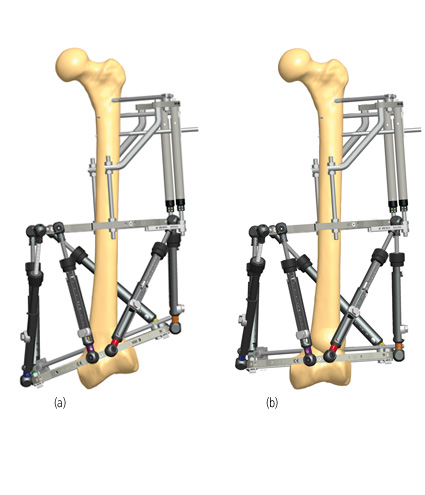
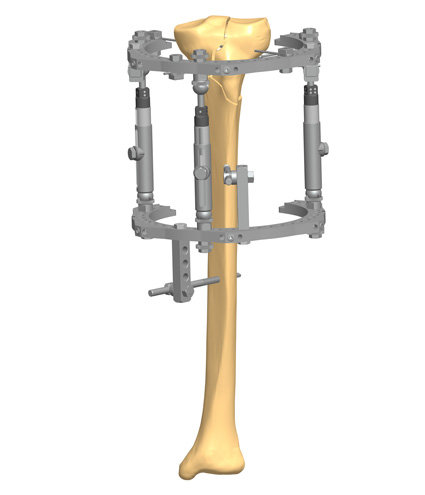
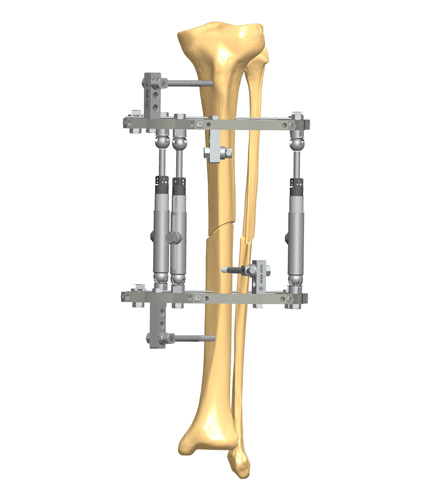
TL-HEX is a hexapod-based system designed at Texas Scottish Rite Hospital for Children (TSRHC), Dallas, TX, as a three-dimensional bone segment reposition module to augment the previously developed TrueLok Ring Fixation System frame. In essence, the system consists of circular and semi-circular external supports secured to the bones by wires and half pins and interconnected by six struts. This allows multi-planar adjustment of the external supports. The rings position is adjusted either rapidly or gradually in precise increments to perform bone segment repositioning in three-dimensional space. As with any other hexapod-type external fixator, an associated planning software, such as OrthoNext, is required to achieve correction.
Clinical Applications
TL-HEX can be used for the correction of bony or soft-tissue defects across a wide range of patient populations. It can be effectively utilized in adult cases as well as in pediatric patients, apart from newborns.
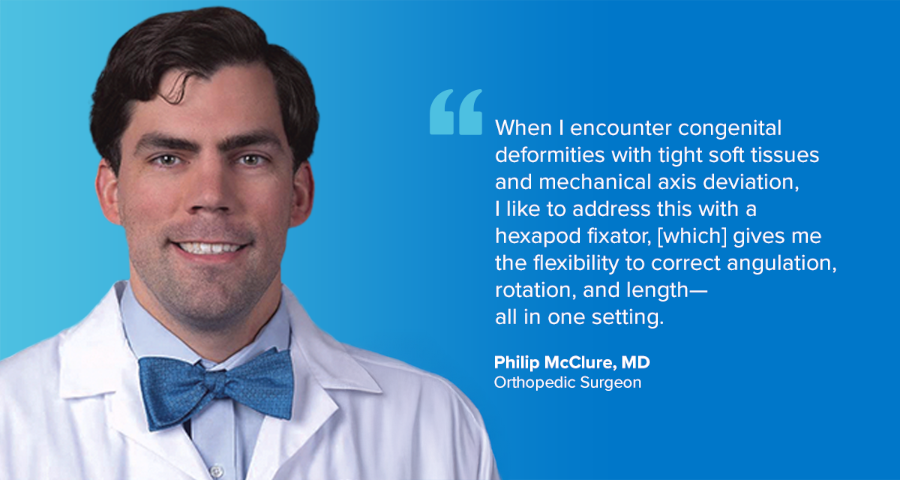
According to Dr. Philip McClure, orthopedic surgeon from the Sinai Hospital in Baltimore: “Skeletal dysplasia and fibular hemimelia are the most common conditions in my practice. When I encounter congenital deformities with tight soft tissues and mechanical axis deviation, I like to address this with a hexapod fixator. TL-HEX gives me the flexibility to correct angulation, rotation, and length – all in one setting.”
Timing and Treatment Decisions
In extremity deformity correction, the timing of intervention is critical for achieving optimal biomechanical and functional outcomes. Treatment planning requires a precise evaluation of remaining growth, natural history of the deformity, and potential compensatory mechanisms. Early intervention may allow for guided growth techniques or less invasive procedures, while delayed treatment often necessitates more complex corrective osteotomies. The decision-making process should integrate patient age, skeletal maturity, etiology, and comorbidities, ensuring that the chosen strategy minimizes recurrence risk and maximizes long-term stability and function.
As Dr. McClure explains, this principle often translates into starting with less invasive procedures before committing patients and families to complex corrections: “For Blount’s disease, if there is growth potential, I try growth modulation first. It gives an impression of how families manage follow-ups and instructions. You should avoid big surgery in patients who can’t handle it or lack social support.”
This stepwise approach reflects the broader principles of extremity deformity correction: when guided growth or minor procedures can provide partial correction, they not only address the pathology early but also serve as a valuable test of patient and family compliance. By the time more demanding surgical interventions are required, both surgeon and family are better prepared for the intensity of treatment, improving the likelihood of long-term success.
Why TL-HEX Is Beneficial for Extremity Deformity Correction
Hexapod ring fixators represent a significant advancement over traditional uniplanar or circular systems in extremity deformity correction. Their computer-assisted, strut-based design allows for simultaneous, multiplanar correction of complex deformities with high precision. Compared to conventional Ilizarov frames, hexapod systems eliminate the need for precision placement of a physical hinge at the apex of a deformity and enable gradual corrections, allowing soft tissue structures to remodel appropriately. The versatility of these systems makes them particularly suitable for both pediatric and adult populations, as well as for managing complex post-traumatic deformities.
TL-HEX combines several features that provide significant advantages for both surgeons and patients in the management of extremity deformities:
- Integrated hardware and dedicated software streamline deformity and trauma management
- Exceptional mechanical stability ensured by the unique aluminum–stainless steel and metal–plastic interface
- Versatility of the strut design, allowing both acute and gradual correction in multiplanar deformities and complex fractures
- Controlled micromotion at the bone site, supporting bone healing and reducing pain
- Precise gradual correction in 0.5 mm increments, improving accuracy and patient tolerance
- Lightweight construction with aluminum rings, enhancing comfort and mobility
- Elimination of a second removal surgery, unlike internal fixation devices
“Relative to other hexapod external fixators, TL-HEX seems to be more stable, and maybe also less painful,” says Dr. McClure. “Patients seem to have less pain and mobilize faster due to the stability of the frame.”
A study on the TL-HEX demonstrated that correction of complex lower limb deformities was achieved in over 90% of cases, with excellent functional outcomes and manageable complication rates.4 In children and in adults as well, hexapod fixators have proven highly effective.3,5
Pre-planning, Surgical Technique and Frame Assembly
The OrthoNext™ software streamlines deformity planning by following established principles such as the Paley method of angles and axes.
Dr. McClure values its clinical and teaching benefits: “There are a couple of things that I really like about the software: one is that it follows the Baltimore limb deformity course or the Paley method. This makes it easy to teach my fellows. For me, I almost pre-build every frame, which saves time in the OR and allows me to focus on the surgery itself.”
This ability to digitally simulate corrections improves both accuracy and efficiency, enhancing communication with patients and families about the expected course of treatment.
While techniques vary by case, some fundamentals remain constant. Reference wires and/or half pins are inserted through safe anatomical corridors to avoid muscle, cartilage, and neurovascular structures. Next, the rings are positioned orthogonally relative to the limb, after which additional wires and/or half pins are inserted into the limb and connected to the rings. Pre-assembling the frame with OrthoNext helps reduce intraoperative time and ensures optimal alignment. Lastly, each strut is attached to both rings, proximal and distal, to complete the frame construct.
Postoperative Care and Rehabilitation
Extremity deformity correction requires structured follow-up and rehabilitation. In example:
- Follow-ups: every 2 weeks during distraction, weekly if needed; then monthly once correction is complete.
- Imaging: X-rays every 2 weeks to monitor regenerate and alignment.
- Physiotherapy: 3–5 sessions per week, including aqua therapy and treadmill programs to maintain mobility and prevent contractures.
“The most important factor is whether the patient is ready for surgery,” Dr. McClure notes. “Timing and compliance are crucial to maintaining good outcomes.”
Complications and Risk Management
As with all advanced procedures, complications can occur. The most frequent ones are pin-site infections and early contractures if physiotherapy is insufficient.
“Pin-site infections are the most common complication. Next to that, the beginning of a contracture is the most frequent. That’s why it is so important to start intensive physiotherapy from the beginning,” says Dr. McClure.
Fractures due to falls and issues with bone consolidation are less common, but close monitoring is essential. Dr. McClure emphasizes realistic expectations: “I always aim for achievable goals. Giving patients unreasonable targets can be devastating.”
Maintaining healthy pin-sites is essential to preventing these complications and ensuring successful outcomes in external fixation. According to Orthofix guidelines, healthy pin-sites depend on both excellent surgical technique during the intra-operative phase and regular pin-site care post-operatively.
Key recommendations include:
- Using atraumatic techniques with sharp drill bits and continuous saline irrigation during pin insertion
- Preventing skin tenting and soft tissue impingement by blunt dissection and careful releases when needed
- Cleaning screw shanks and surrounding skin regularly with sterile water and avoiding tethering of the skin
- Ensuring all care providers – surgeons, nurses, patients, and families – understand the post-operative pin-site care protocol
By combining meticulous technique, evidence-based pin-site care, and early physiotherapy, the risk of infection and contracture can be significantly reduced, helping patients achieve optimal results with TL-HEX.
For more information on the subject please consult Key Points for Healthy Pin Sites from Orthofix.
Compatibility of the TrueLok Ring Fixation Family
All components of the TL-HEX are compatible with the TrueLok Ring Fixation System; therefore, external supports from both systems can be connected to each other when building fixation blocks. All the basic components from the TrueLok Ring Fixation System (wire and half pin fixation bolts, posts, threaded rods, plates as well as other assembly components and instrumentation) should be utilized with the TL-HEX system.
“When I’m done with the correction and we want to reduce some of the bulk of the frame or make X-rays easier, I sometimes wrap and adjust the struts. They remain stable, but the bulk decreases. I also use the TrueLok rings, for example, to build an arch,” says Dr. McClure.
This adaptability ensures the device can be tailored to individual requirements throughout the entire treatment process.
Explore real-world limb reconstruction cases and deepen your clinical practice: access the dedicated clinical resources here.
Patient Outcomes and Satisfaction
As Dr. McClure highlights, the stability and versatility of TL-HEX provide a smoother treatment pathway for patients, with less pain, faster mobilization, and improved satisfaction. Families appreciate the predictability of outcomes and the structured rehabilitation protocols that accompany the system.
Case Reports
A clinical case further illustrates the role of hexapod fixation in managing complex deformities involving both bone loss and growth disturbance. A 2-year-old patient presented with post-infectious distal tibial growth arrest, associated angular deformity, limb length discrepancy, and segmental bone defect following MRSA osteomyelitis.
A staged reconstruction strategy was adopted, combining initial infection management and defect reconstruction with subsequent gradual deformity correction and lengthening using the TL-HEX™ TrueLok Hexapod System. The system enabled precise multiplanar correction while maintaining stability in a challenging anatomical context, including short metaphyseal segments and previous surgical interventions.
Despite the complexity of the case and the need for multiple procedures, final outcomes demonstrated restoration of alignment, approximately 5 cm of lengthening, and return to full activity with minimal pain during treatment.
This case highlights the value of hexapod systems in addressing complex, multi-stage deformity correction scenarios where precision, adaptability, and controlled gradual correction are essential.
Download the full case report to explore the complete treatment strategy, surgical stages, and long-term outcomes.
The case report shows an individual’s response to treatment. The information contained in this case report is provided for informational and educational purposes. It is not intended to guarantee the response other people may have to treatment as individual results can and do vary. Proper surgical procedure is the responsibility of the medical professional. Each surgeon must evaluate the appropriateness of a technique based on his or her personal medical credentials and experience.
Orthofix Extremity Deformity Correction Portfolio
Correcting deformities of the extremities requires precise planning and cutting-edge orthopedic solutions to restore alignment, balance, and function. Whether the condition is congenital or acquired, our approach combines specific patient treatments with state-of-the-art fixation and distraction technologies. The Extremity Deformity Correction portfolio includes the TL-HEX™, TrueLok™ EVO, Rodeo™ Telescopic Nail, and the LRS Advanced Limb Reconstruction System. Learn more on Orthofix.com.
Education and Orthofix Academy
Orthofix Orthopedics has redefined its global focus to concentrate on Limb Reconstruction, addressing complex congenital, developmental, and acquired conditions in patients of all ages.
To maximize surgical outcomes, Orthofix provides a series of resources complemented by Orthofix Academy, a dedicated platform for education and skill development in limb reconstruction.
By combining innovative technology with continuous learning opportunities, Orthofix supports surgeons in delivering the highest standards of care.
Stay Connected
- Instagram: Follow @OrthofixOrthopedics for exclusive tips, updates, and stories from the field.
- LinkedIn: Connect with us on our corporate LinkedIn Page to access news, thought leadership, industry updates, and career opportunities.
- YouTube: Subscribe to the Orthofix Orthopedics YouTube channel for educational videos.
Follow us today and join this growing community, united by a shared passion and mission to improve the lives of our patients.
The information in this article is intended exclusively for healthcare professionals. Federal law (USA) restricts these devices to sale by or on the order of a physician. Proper surgical procedure is the responsibility of the medical professional. Operative techniques are furnished as an informative guideline. Each surgeon must evaluate the appropriateness of a technique based on his or her personal medical credentials and experience.
Dr. Philip McClure is a paid consultant of Orthofix.
References
- O’Farrell P, Barnard AC, Birkholtz F. The tibial bayonet method of wound closure. Strategies in trauma and limb reconstruction (Online) 2018; 13(2): 103-8.
- Iobst C, Ferreira N, Kold S. A Review and Comparison of Hexapod External Fixators: Current Concept Review. JPOSNA. 2023;5(1).
- Rodriguez-Collazo E, Frania S, Hyrczyk J. Orthoplastic consideration during distal tibia deformity and limb lengthening utilizing TrueLok hexapod circular external fixator. JOTSRR 2018; 13(1): 10-3.
- Ferreira N, Marais LC. Management of tibial nonunions according to a novel treatment algorithm. Injury 2015; 46(12): 2422-7.
- Pesenti S, Iobst CA, Launay F. Evaluation of the external fixator TrueLok Hexapod System for tibial deformity correction in children. Orthopaedics & traumatology, surgery & research: OTSR 2017; 103(5): 761-4.


